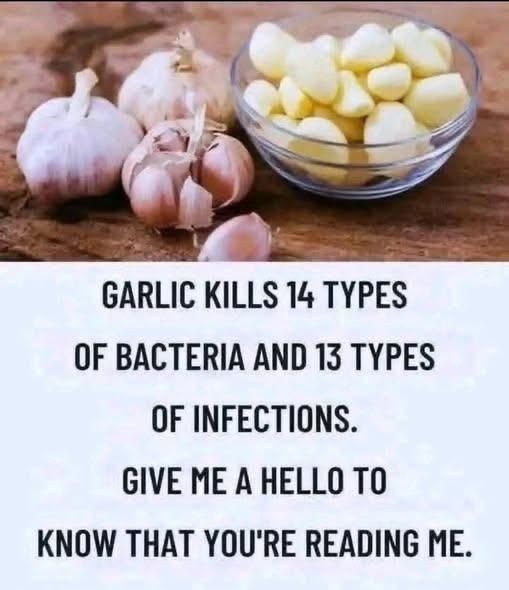
Garlic’s antimicrobial properties, but the statement “garlic eliminates 14 types of bacteria and 13 types of infections” is not scientifically precise. Let me explain carefully:
1. Garlic’s Antimicrobial Properties
-
Garlic contains allicin, a sulfur-containing compound that forms when garlic is crushed or chopped.
-
Allicin has been shown in lab studies to inhibit the growth of certain bacteria, viruses, and fungi.
-
Some studies suggest garlic can act against bacteria like E. coli, Staphylococcus aureus, Salmonella, and H. pylori.
2. What “14 types of bacteria and 13 types of infections” means
-
There is no standard scientific study that categorically proves garlic kills exactly 14 types of bacteria or cures 13 types of infections.
-
Most research is in vitro (in lab dishes), not in humans, so results may not directly translate to treating infections in real life.
-
Garlic may help support immunity and may reduce risk or severity of certain infections, but it cannot replace antibiotics or medical treatment.
3. Safe Use of Garlic
-
Raw garlic: may have stronger antimicrobial activity, but can irritate the stomach or cause bad breath.
-
Cooked garlic: still beneficial but less potent against microbes.
-
Garlic supplements: some studies show benefits, but doses and effectiveness vary.
Bottom line: Garlic has antimicrobial properties and may help prevent or fight some infections, but the claim of “eliminating exactly 14 bacteria and 13 infections” is an exaggeration. It’s best seen as a supportive food rather than a cure.