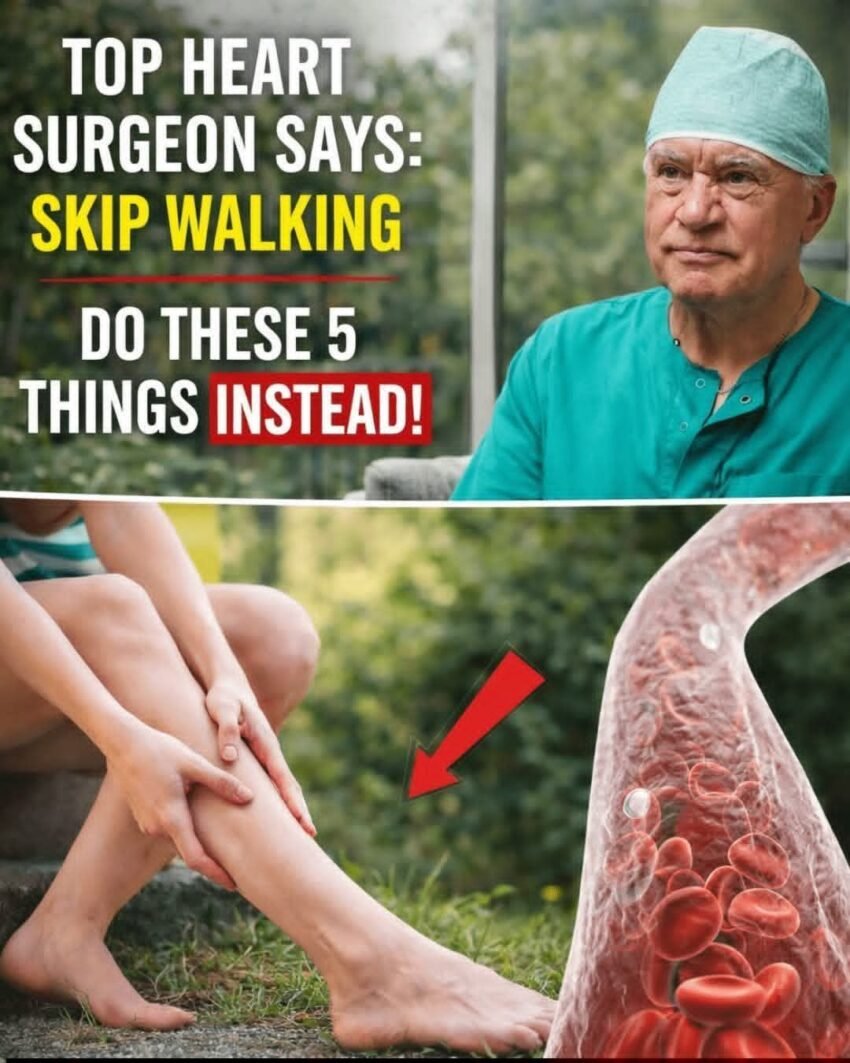
A “top heart surgeon” says to skip walking
- Claims there are “5 things” better than walking
- Implies walking may be harmful or ineffective
- Uses dramatic visuals (leg pain, blood vessel graphic, authoritative-looking doctor)
None of this is supported by credible medical evidence as presented.
What’s actually happening here
1. The “top heart surgeon” claim
- The image does not name the surgeon.
- There is no verifiable source, study, or medical institution cited.
- This is a classic appeal to authority tactic used in clickbait.
If a real, reputable surgeon made a recommendation like this, it would:
- Be published in medical journals
- Be echoed by cardiology associations
- Include context, limitations, and patient-specific guidance
None of that is present.
2. “Skip walking” is misleading
Walking is:
- One of the most strongly recommended exercises by cardiologists worldwide
- Proven to reduce risk of:
- Heart disease
- Stroke
- Type 2 diabetes
- High blood pressure
- Premature death
No major heart association advises people to stop walking in general.
What is true:
- Walking may not be sufficient alone for everyone
- Some people benefit from additional or alternative exercises
- People with joint pain or vascular disease may need modifications, not avoidance
That nuance is missing in the image.
3. The leg pain and blood vessel imagery
These visuals suggest:
- Walking causes circulation problems
- Walking worsens leg pain or blood flow
Reality:
- For most people, walking improves circulation
- It is actually a first-line therapy for peripheral artery disease (PAD)
- Leg pain during walking should be evaluated, not used as a reason to stop activity altogether
The image uses fear-based visuals without explanation.
4. “Do these 5 things instead”
This is a common funnel tactic:
- Step 1: Undermine a trusted habit (walking)
- Step 2: Create fear or doubt
- Step 3: Promise a “better” secret
- Step 4: Lead to a video, supplement, or paid program
Without seeing the actual “5 things,” there is no scientific credibility.
What reputable medicine actually says
A medically accurate position would be:
- Walking is excellent for heart health
- Some people may benefit from adding:
- Strength training
- Interval training
- Balance or flexibility exercises
- Exercise should be personalized, not one-size-fits-all
- Pain, numbness, or fatigue during walking should prompt medical evaluation, not blanket avoidance
Who should be cautious (not stop walking, but adjust)
Walking may need modification for people with:
- Severe arthritis
- Advanced peripheral artery disease
- Certain nerve or spine conditions
- Recent surgery or injury
Even then, doctors usually recommend alternative movement, not inactivity.
A safe, accurate way to reword the claim
Instead of what the image says, a truthful version would be:
“Walking is a great foundation for heart health, but some people may benefit from combining it with other types of exercise depending on their condition.”
Or:
“For certain individuals, other forms of low-impact or strength-based exercise may complement or improve upon walking alone.”
Bottom line
- This image is misleading and oversimplified
- It uses authority + fear + vagueness
- Walking is not bad for your heart
- No drink, exercise, or habit should be framed as a universal replacement without context